Painting the Ghost Train: Why Amok Island’s Geometric Murals Are a Desperate Love Letter to Earth
What happens when you realize you're trying to catalogue a burning library while the books are already turning to ash in your hands?
Every year, headlines bring bizarre and fleeting moments of hope—biologists stumble across a brand-new wild cat in the rugged terrain of Bolivia, or deep-sea initiatives dredge up bizarre marine organisms that look like they belong in science fiction. But if you take a step back and think about it, these discoveries are bittersweet anomalies. In my opinion, we are playing a desperate game of biological hide-and-seek, desperately naming things just as they slip quietly into the dark abyss of extinction. What many people don't realize is that our ignorance about the planet's baseline biodiversity is staggering; we have no idea how many species are disappearing because we haven't even met them yet.
The Geometry of Grief and Wonder
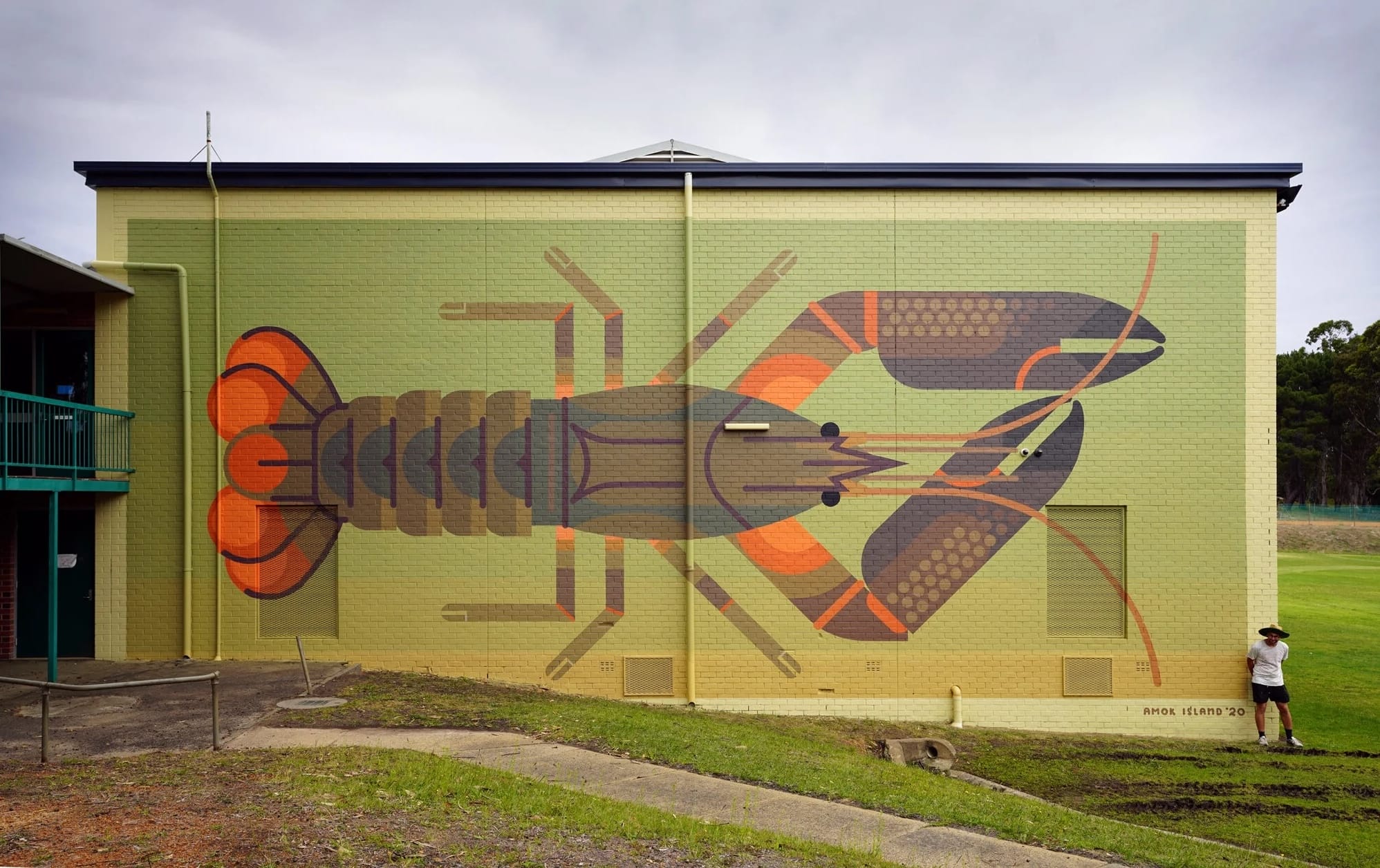
This exact tension is what makes the work of Amsterdam-born, Fremantle-based artist Amok Island so deeply compelling to me. A detail that I find especially interesting is how he uses rigid, crisp geometric patterns to depict the chaotic, organic wildness of nature. Across massive industrial walls, dreary community buildings, and urban landscapes, he paints local mammals, crustaceans, and native flora with a precision that feels almost scientific.
Personally, I think there is a profound psychological poetry in using clean lines and structured shapes to represent living things that are currently being dismantled by human-caused habitat loss and climate change. What this really suggests is a human desire to impose order on a world that feels increasingly unhinged. When you see a flock of migrating birds or a cluster of vibrant wildflowers rendered in such calculated precision on a concrete wall, it forces a jarring collision between our manufactured world and the wild things we are systematically erasing.
Bringing the Wilderness Back to the Pavement
What makes Amok Island's murals particularly fascinating is their localized focus. He doesn't just paint generic nature scenes; he curates exact snapshots of the local ecosystem for the people who walk past those walls every single day.
From my perspective, this is a brilliant antidote to the modern condition of ecological detachment. Most of us live in concrete cages, entirely disconnected from the regional flora and fauna that share our zip codes. We care about the Amazon rainforest because it's a grand global symbol, but we walk right past the native insects and endemic plants struggling in our own backyards. By plastering these creatures across urban infrastructure, the artist is essentially holding up a mirror to the community and asking, "Do you even know what you're losing?" It bridges that invisible gap between human indifference and local environmental stewardship.
The Larger Cultural Blind Spot
If you look at how we talk about conservation globally, it’s always framed in distant, apocalyptic terms—melting ice caps, abstract temperature targets, and vanishing species on distant continents. But what people usually misunderstand about conservation is that it starts with local intimacy.
This raises a deeper question: Can we truly care about the global biosphere if we are entirely alienated from the dirt beneath our feet? I strongly believe that art like Amok Island’s serves a crucial cultural function that scientific reports simply cannot match. Numbers and extinction rates wash over our brains like white noise. A striking, geometric rooster or a vibrant crustacean painted twenty feet tall on a brick wall, however, demands an emotional response. It transforms abstract loss into a tangible, local presence.
A Final Thought on Painted Legacies
Ultimately, these murals function like brilliant, colorful ghosts. They celebrate the breathtaking diversity of the earth while silently reminding us of how fragile those populations really are.
One thing that immediately stands out to me is the sheer irony of painting nature on the very concrete walls that displaced it. Yet, perhaps that contradiction is precisely the point. As we hurtle forward into an uncertain ecological future, we need creators who don't just document the natural world, but force us to look it square in the eye before it becomes nothing more than a memory painted on a wall.